Siri is an intelligent software assistant that Apple developed. It enables you to speak to your iphone to set appointments, get directions, send texts and calls, and finds contacts. Some positives to this would be if you were driving you could just ask your phone for directions, or send text messages without taking your eyes off the road. This is useful because texting and driving is illegal, this is a safe way to send texts if you really need to. It also helps you keep focused on the road and not on the machine. Another good thing about Siri is that it's assessable to people who are vision impaired. This helps because they would be able to use most parts of the iPhone. Some negatives to this software is that it doesn't recognize some voices. If someone has a strong accent it doesn't work. An example is in the video below.
Friday, January 6, 2012
Frankenstein Technology
Siri.
Siri is an intelligent software assistant that Apple developed. It enables you to speak to your iphone to set appointments, get directions, send texts and calls, and finds contacts. Some positives to this would be if you were driving you could just ask your phone for directions, or send text messages without taking your eyes off the road. This is useful because texting and driving is illegal, this is a safe way to send texts if you really need to. It also helps you keep focused on the road and not on the machine. Another good thing about Siri is that it's assessable to people who are vision impaired. This helps because they would be able to use most parts of the iPhone. Some negatives to this software is that it doesn't recognize some voices. If someone has a strong accent it doesn't work. An example is in the video below.
This is an unfortunate disadvantage for people in countries other than Canada, United States, and Britain. Personally I would not buy an iphone 4s. Simply because I don't think being able to talk out commands is that much less time consuming. Especially if it takes more than one try to get it to figure out what you are saying. I think it's easier and much faster to just tap instead of talking to it.
Siri is an intelligent software assistant that Apple developed. It enables you to speak to your iphone to set appointments, get directions, send texts and calls, and finds contacts. Some positives to this would be if you were driving you could just ask your phone for directions, or send text messages without taking your eyes off the road. This is useful because texting and driving is illegal, this is a safe way to send texts if you really need to. It also helps you keep focused on the road and not on the machine. Another good thing about Siri is that it's assessable to people who are vision impaired. This helps because they would be able to use most parts of the iPhone. Some negatives to this software is that it doesn't recognize some voices. If someone has a strong accent it doesn't work. An example is in the video below.
Sunday, January 1, 2012
Ignorance is Bliss?
In Frankenstein, the monster was at peace when he was just "born" or created. He didn't know about the harshness of the world. When he learns language and can read he is brought to know all of the dangers and cruelness he has been facing. He begins to understand why people would run from him and exclude him, he probably hadn't even known that they were doing that at the time. He becomes hurt and upset at humans and that's when he starts to kill. This wouldn't be this way if he didn't learn. Learning is what causes pain and confusion.
In Mr. Lobb's class, we are constantly faced with new knowledge of the world. As this is done, there are many people who are upset at the end of the class. They come to realize that the world isn't how they thought it was. Before this English class, those girls were happy only knowing what they had been taught by guarding parents and friends. After they found out about what was really going on in the world, they think about how awful it all is. They say things like, "This is terrible", "Why would you show us this!" and other comments about their confusion and realizations. This is why ignorance is bliss. People feel better when they don't know about things that are happening, when they do know, they become upset and overwhelmed.
Sunday, December 11, 2011
Soliloquy #5 Act 3 scene 1
To Be thus is nothing.
To be this is nothing, but to be safely this. I fear Banquo, and that he will have royal sons. He is daring, and thinks all of the time, he has wisdom that guides him safely. I fear no one except Banquo. When I am around him my guardian is scared, as Mark Antony's was afraid of Caesar. Banquo got angry at the witches when they told me I would be king. He begged them to tell is future. Prophet-like they told him he would be the father to a line of kings. They had given me a crown that I couldn't pass onto my children (They told me I would be king but my children wouldn't). If it was true, Banquo's children will take my place in royalty instead of my own. If it is true, then I have killed Duncan for Banquo's children, and put my conscience out of peace for them. I handed my soul to the devil for Banquo's children to be kings. Rather than this happen, i will fight for my sons to be king.
But to be safely thus.--Our fears in Banquo
Stick deep; and in his royalty of nature
Reigns that which would be fear'd: 'tis much he dares;
And, to that dauntless temper of his mind,
He hath a wisdom that doth guide his valour
To act in safety. There is none but he
Whose being I do fear: and, under him,
My Genius is rebuked; as, it is said,
Mark Antony's was by Caesar. He chid the sisters
When first they put the name of king upon me,
And bade them speak to him:
then prophet-like
They hail'd him father to a line of kings:
Upon my head they placed a fruitless crown,
And put a barren sceptre in my gripe,
Thence to be wrench'd with an unlineal hand,
No son of mine succeeding. If 't be so,
For Banquo's issue have I filed my mind;
For them the gracious Duncan have I murder'd;
Put rancours in the vessel of my peace
Only for them; and mine eternal jewel
Given to the common enemy of man,
To make them kings, the seed of Banquo kings!
Rather than so, come fate into the list.
And champion me to the utterance!
Stick deep; and in his royalty of nature
Reigns that which would be fear'd: 'tis much he dares;
And, to that dauntless temper of his mind,
He hath a wisdom that doth guide his valour
To act in safety. There is none but he
Whose being I do fear: and, under him,
My Genius is rebuked; as, it is said,
Mark Antony's was by Caesar. He chid the sisters
When first they put the name of king upon me,
And bade them speak to him:
then prophet-like
They hail'd him father to a line of kings:
Upon my head they placed a fruitless crown,
And put a barren sceptre in my gripe,
Thence to be wrench'd with an unlineal hand,
No son of mine succeeding. If 't be so,
For Banquo's issue have I filed my mind;
For them the gracious Duncan have I murder'd;
Put rancours in the vessel of my peace
Only for them; and mine eternal jewel
Given to the common enemy of man,
To make them kings, the seed of Banquo kings!
Rather than so, come fate into the list.
And champion me to the utterance!
Saturday, December 10, 2011
Soliloquy #4. Act 2, scene 1.
Is this a dagger which I see before me,
The handle toward my hand? Come, let me clutch thee.
I have thee not, and yet I see thee still.
Art thou not, fatal vision, sensible
To feeling as to sight? or art thou but
A dagger of the mind, a false creation,
Proceeding from the heat-oppressed brain?
I see thee yet, in form as palpable
As this which now I draw.
Thou marshall'st me the way that I was going;
And such an instrument I was to use.
Mine eyes are made the fools o' the other senses,
Or else worth all the rest; I see thee still,
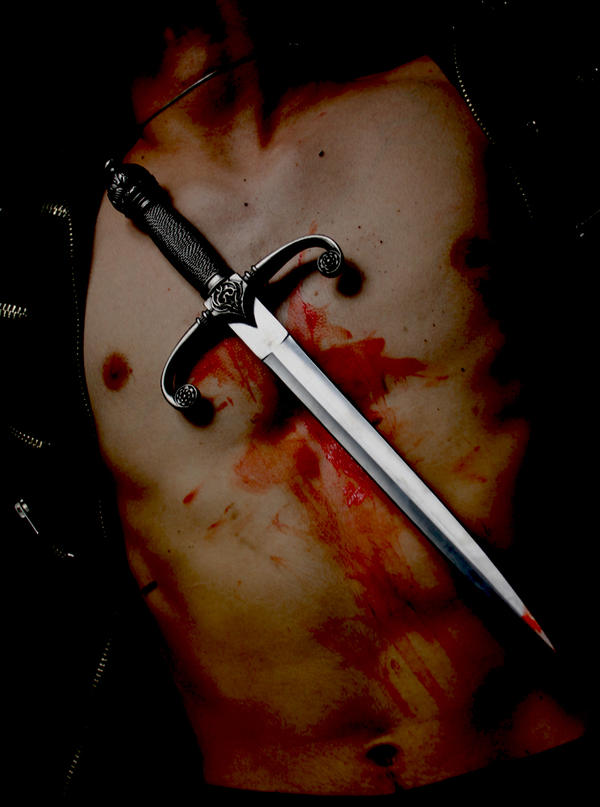
And on thy blade and dudgeon gouts of blood,
Which was not so before. There's no such thing:
It is the bloody business which informs
Thus to mine eyes. Now o'er the one half-world
Nature seems dead, and wicked dreams abuse
The curtain'd sleep; witchcraft celebrates
Pale Hecat's off'rings; and wither'd Murder,
Alarum'd by his sentinel, the wolf,
Whose howl's his watch, thus with his stealthy pace,
With Tarquin's ravishing strides, towards his design
Moves like a ghost. Thou sure and firm-set earth,
Hear not my steps, which way they walk, for fear
Thy very stones prate of my whereabout,
And take the present horror from the time,
Which now suits with it. Whiles I threat, he lives:
Words to the heat of deeds too cold breath gives.
A bell rings.
I go, and it is done; the bell invites me.
Hear it not, Duncan; for it is a knell
That summons thee to heaven or to hell.
The handle toward my hand? Come, let me clutch thee.
I have thee not, and yet I see thee still.
Art thou not, fatal vision, sensible
To feeling as to sight? or art thou but
A dagger of the mind, a false creation,
Proceeding from the heat-oppressed brain?
I see thee yet, in form as palpable
As this which now I draw.
Thou marshall'st me the way that I was going;
And such an instrument I was to use.
Mine eyes are made the fools o' the other senses,
Or else worth all the rest; I see thee still,
And on thy blade and dudgeon gouts of blood,
Which was not so before. There's no such thing:
It is the bloody business which informs
Thus to mine eyes. Now o'er the one half-world
Nature seems dead, and wicked dreams abuse
The curtain'd sleep; witchcraft celebrates
Pale Hecat's off'rings; and wither'd Murder,
Alarum'd by his sentinel, the wolf,
Whose howl's his watch, thus with his stealthy pace,
With Tarquin's ravishing strides, towards his design
Moves like a ghost. Thou sure and firm-set earth,
Hear not my steps, which way they walk, for fear
Thy very stones prate of my whereabout,
And take the present horror from the time,
Which now suits with it. Whiles I threat, he lives:
Words to the heat of deeds too cold breath gives.
A bell rings.
I go, and it is done; the bell invites me.
Hear it not, Duncan; for it is a knell
That summons thee to heaven or to hell.
My eyes are now weak compared to my other senses, if not are as good as the rest of my senses. I see the dagger still, and now on the blade is drenched in blood, which was not there before. There's no such thing. I am seeing what the blade will look like after I kill Duncan.
The world will be half of what it is, nature seems dead, and nightmares waken you from your sleep. Witchcraft will come from the goddess of magic. The wolves will howl an alarm who are keeping watch. Tarquin's enchanting strides towards him, moves like a ghost. I beg that the Earth does not hear my steps, or know where I'm going. I fear that the stones can speak and know where I am, and take the silence in the dead of night. While I'm thinking about killing him, he's alive, speaking of killing him makes me not want to kill him anymore. I'll go to kill him, so it will be done, the bell invites me. Don't hear the bell Duncan, for it is the death bell that will take you to heaven or to hell.
Friday, December 9, 2011
Soliloquy # 3 Act 1 Scene 7.
MACBETH:
If it were done when 'tis done, then 'twere well
It were done quickly: if the assassination
Could trammel up the consequence, and catch
With his surcease success; that but this blow
Might be the be-all and the end-all here,
But here, upon this bank and shoal of time,
We'ld jump the life to come. But in these cases
We still have judgment here; that we but teach
Bloody instructions, which, being taught, return
To plague the inventor: this even-handed justice
Commends the ingredience of our poison'd
Chalice To our own lips. He's here in double trust;
First, as I am his kinsman and his subject,
Strong both against the deed; then, as his host,
Who should against his murderer shut the door,
Not bear the knife myself. Besides, this Duncan
Hath borne his faculties so meek, hath been
So clear in his great office, that his virtues
Will plead like angels, trumpet-tongued, against
The deep damnation of his taking-off; 20
And pity, like a naked new-born babe,
Striding the blast, or heaven's cherubin, horsed
Upon the sightless couriers of the air,
Shall blow the horrid deed in every eye,
That tears shall drown the wind. I have no spur
To prick the sides of my intent, but only
Vaulting ambition, which o'erleaps itself
And falls on th'other.
If I have to kill him, it's better that it's done quickly. If the assasination could prevent all the consequences, then it will be-all and end-all. But here in this time we would skip our after life. In this case we still have judgment, we are taught to kill by the king, and are being taught to kill the king. This even justice praises the quality of our poison we are about to drink (Justice would think it's good that we are about to kill Duncan. That Macbeth deserves to be king, that the king's death would be justice for any wrong-doings Duncan did.) I am stuck in a difficult place, I am trusted by the king in two ways at this point, first as his kinsman and a subject of his ruling power, any other person like me would be against killing him. Second, I am his host, who should protect the King of a killer, not be the killer myself. Duncan has made his power so weak, has been so clear in his ruling that his courage will plead like strong angels against the killing. Will make us feel pity, like a new born baby. The news of killing the king will be spread around to everyone like it was floating in the wind, and that tears will stop the wind. I have no reason to kill the king (Nothing against him) only my ambition to be king myself, which overpowers any reason and falls on the other side of wanting to be king myself.
In this he is making the decision to kill the king because he wants to be king, not for any dislike for the king.
If it were done when 'tis done, then 'twere well
It were done quickly: if the assassination
Could trammel up the consequence, and catch
With his surcease success; that but this blow
Might be the be-all and the end-all here,
But here, upon this bank and shoal of time,
We'ld jump the life to come. But in these cases
We still have judgment here; that we but teach
Bloody instructions, which, being taught, return
To plague the inventor: this even-handed justice
Commends the ingredience of our poison'd
Chalice To our own lips. He's here in double trust;
First, as I am his kinsman and his subject,
Strong both against the deed; then, as his host,
Who should against his murderer shut the door,
Not bear the knife myself. Besides, this Duncan
Hath borne his faculties so meek, hath been
So clear in his great office, that his virtues
Will plead like angels, trumpet-tongued, against
The deep damnation of his taking-off; 20
And pity, like a naked new-born babe,
Striding the blast, or heaven's cherubin, horsed
Upon the sightless couriers of the air,
Shall blow the horrid deed in every eye,
That tears shall drown the wind. I have no spur
To prick the sides of my intent, but only
Vaulting ambition, which o'erleaps itself
And falls on th'other.
If I have to kill him, it's better that it's done quickly. If the assasination could prevent all the consequences, then it will be-all and end-all. But here in this time we would skip our after life. In this case we still have judgment, we are taught to kill by the king, and are being taught to kill the king. This even justice praises the quality of our poison we are about to drink (Justice would think it's good that we are about to kill Duncan. That Macbeth deserves to be king, that the king's death would be justice for any wrong-doings Duncan did.) I am stuck in a difficult place, I am trusted by the king in two ways at this point, first as his kinsman and a subject of his ruling power, any other person like me would be against killing him. Second, I am his host, who should protect the King of a killer, not be the killer myself. Duncan has made his power so weak, has been so clear in his ruling that his courage will plead like strong angels against the killing. Will make us feel pity, like a new born baby. The news of killing the king will be spread around to everyone like it was floating in the wind, and that tears will stop the wind. I have no reason to kill the king (Nothing against him) only my ambition to be king myself, which overpowers any reason and falls on the other side of wanting to be king myself.In this he is making the decision to kill the king because he wants to be king, not for any dislike for the king.
Monday, December 5, 2011
Looking At Emotion
Happy
emotions venture to an upbeat state
a smile upon your sun struck mouth
rosy cheeks and eyes so bright
one to other and back again
nothing
empty, emotionless, lost in space
mouth is straight and boring
eyes are dazed and start to close
others can not change it.
Sad
broken feelings flooding fast
tongue is dry and chin is shaking
flowing eyes filled with pain
one could have produced this.
Angry
quick is blame and always nasty
loud mouth words are spewing
eyebrows arched an evil way
others give and receive it.
emotions venture to an upbeat state
a smile upon your sun struck mouth
rosy cheeks and eyes so bright
one to other and back again
nothing
empty, emotionless, lost in space
mouth is straight and boring
eyes are dazed and start to close
others can not change it.
Sad
broken feelings flooding fast
tongue is dry and chin is shaking
flowing eyes filled with pain
one could have produced this.
Angry
quick is blame and always nasty
loud mouth words are spewing
eyebrows arched an evil way
others give and receive it.
Alone analysis
From childhood's hour I have not been
As others were; I have not seen
As others saw; I could not bring
My passions from a common spring.
From the same source I have not taken
My sorrow; I could not awaken
My heart to joy at the same tone;
And all I loved, I loved alone.
Then- in my childhood, in the dawn
Of a most stormy life- was drawn
From every depth of good and ill
The mystery which binds me still:
From the torrent, or the fountain,
From the red cliff of the mountain,
From the sun that round me rolled
In its autumn tint of gold,
From the lightning in the sky
As it passed me flying by,
From the thunder and the storm,
And the cloud that took the form
(When the rest of Heaven was blue)
Of a demon in my view.
Alone - isolated, unique, solitary, unequaled. This has meaning to what is in the poem. During Edgar's childhood, he had to deal with many different challenges. I think what started all of the hardships was his parents dieing when before he turned three. From there, he was made to live with a tobacco merchant, and his siblings had went to live somewhere else. His brother died at an early age where he would have became a poet. This is just the start of the terrible things that happen to Edgar Allan Poe.
In my childhood, I wasn't like the others, I didn't have the same views as the other children. We didn't have any common passions or interests. I didn't feel sad or happy the same way they did. No one loved what I loved. The beginning of my childhood was the start of my terrible life. What happened later in my childhood (not fitting in) was drawn from good and bad. It's a mystery that I still don't understand. I don't understand the heavy rain or fountains, how there's a red cliff on the mountain, the sun rolls across my sky, how it looks like gold in the fall. How lightning flies through the sky, and how a demon(hardship/challenge) was placed before me when the other part of my life was alright (before my parents died).
Edgar Allan Poe Biography
Edgar Allan Poe was born in 1809. In this time period many countries were fighting for independence such as Mexico, Greece, Chile, and Peru. When Edgar Allan Poe was no more than three his parents had died and he was made to live with a tobacco merchant in Richmond. Poe's two siblings had went to live with other families. His sister became a school teacher and his brother was a poet until his early death. He went to a school while living in England for five years. At just 13 he had enough poems to publish a book but was advised against it. He moved back to america with the Allans from 1821-1825.
In 1826 he went to Virginia University, but was overcome with debt. He took up gambling to try to win money back but ended up losing most of his money. He was so in debt that he burned his furniture to keep warm. He purposely failed out of university and went back home. He had a fight with John Allen because Edgar claimed he didn't give him enough money for university expenses. Allen was upset with Edgar because he spent all of his money gambling. When Edgar got to Richmond, he realized that when he was away his fiancée married another man. He then enlisted in the army in 1827. France Allan dies in 1829. Edgar is discharged from the army a month after her death. He moves to Baltimore and lives with his aunt and her daughter in 1831. Edgar falls in love with her daughter ( his 13 year old cousin, Virginia) and marries her in 1836. In 1834, John Allan dies, and leaves Edgar out of his will. In 1847, his wife dies, and he becomes ill. 1849, he gets engaged to the same women that married another man in his absence. He dies the same year, after he is found delirious and unconscience in Baltimore.
After Edgar meets his cousin he publishes the poem " To Helen". To Helen talks about how beautiful a women is, this could be referring to Virginia, or his aunt who took him in when he was so poor. The poem "Annabel Lee" could be thought to be about Virginia and her death. It's about a young love and about how a cool wind came in and killed her. Edgar and Virginia fell in love when they were young, and Edgar married Virginia when she was 13. This is seen in his poem "Annabel Lee".
Monday, November 21, 2011
#1PoetryAssignment-Inching Closer to the Assumed Truth
Stepping across the unreal rivergrass has never made this home
time will pass and grow to falter
child's play is still anew
What can bring this to a norm
to make this not the same
not for pageant or for fair
just to let then go
Unknown faces make their way
through realized dreams they had.
seems still waiting for the time
making it unfold
Hurry now as time will fade
now is in a fresh new sight
finding only shelter will
increase their fame
Making shadows on the wall
imagine they can speak
for as you know they are to you
more real than the river
If time will falter
and dreams be made
hope will reach there soon
but until now they never knew
its just a game to play
Tuesday, November 8, 2011
Soliloquoy #2. Act 1, scene 5
The raven himself is hoarse
That croaks the fatal entrance of Duncan 40
Under my battlements. Come, you spirits
And fill me from the crown to the toe top-full
Of direst cruelty! make thick my blood;
Stop up the access and passage to remorse,
The effect and it! Come to my woman's breasts,
And take my milk for gall, you murdering ministers,
Wherever in your sightless substances 50
You wait on nature's mischief! Come, thick night,
To cry 'Hold, hold!'
Even the birds are sore and croak because they know Duncan is going to die in my castle. Some spirits and fill me with cruelty I need to be able to kill the king. Make me tough, stop myself from feeling remorse and guilt. That nature's guilt can not make me not want to do what I intend or put guilt between the murder and the consequences. Murdering ministers, make my woman breast milk parasitic. You wait for mischief. I wait for night, make my murder's knife not see what it murders or let heaven look at what I do and tell me to stop.
Subscribe to:
Posts (Atom)